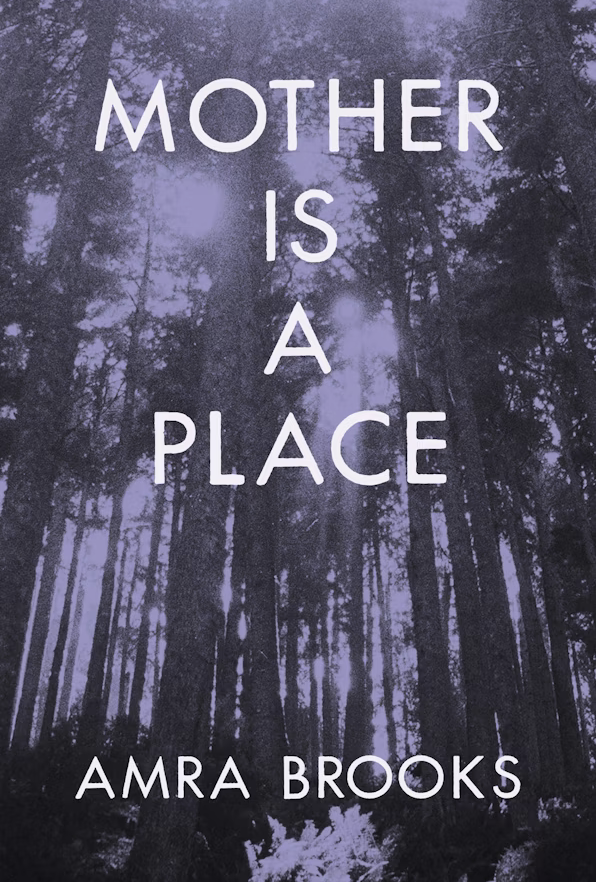
When Amra Brooks' parents split, so did her life—half lived with her queer, punk, addict dad in Los Angeles, and half with her struggling mom in Santa Cruz. With a poetic tone and an eye for rough beauty, Mother is a Place details one girl's dogged search for safety and care, a pursuit that brings her from idyllic literary studies to nannying for an iconic, out-of-control rock star, from her mysteriously collapsing body to the defiant tenderness of motherhood. Says Girlhood author Melissa Febos, Mother Is a Place is 'a beautiful and finely told story of becoming, this memoir is both map and guide—to bearing what we are given, the path to home, and all that is possible to build ourselves.'
PRAISE FOR MOTHER IS A PLACE
“FINALLY someone is speaking open the body of motherhood with a rebel yell. Amra Brooks’ brilliant book Mother Is A Place is a rocking, rolling, revolutionary story that breaks previous mother tropes open to reveal a mind-blowing truth: women are fully human, fully-embodied, complex and beautiful beings navigating a world hell-bent on their erasure. In the face of broken families, relationship estrangements, shapeshifting selves and a series of jack-knifing experiences, Mother Is a Place takes back erotic power. A blood song of being.”
–Lidia Yuknavitch, bestselling author of the novels The Book of Joan, The Small Backs of Children, and Dora: A Headcase, and of the memoir The Chronology of Water
“Amra Brooks’s candor and beautiful writing kept me turning page after page of Mother Is a Place. Her writing is both charming and alarming. Her unadorned style results from her finding the right words for impossible situations, the right tone for its gravity and humor, all delivered without a trace of mawkish self-pity. Brooks has written a genuine, compelling bildungsroman, an unforgettable story. It’s a wonderful book.
- Lynne Tillman, author of Men and Apparitions and Mothercare
This is the kind of book you just drink. Amra Brooks’s only child saga shifts its attention like a running stream full of beautiful heartbreaking things that makes you thirsty for more. I hated to leave. Though it’s not bad to read it again. What a relief, a book that envelopes, that simply lets you in.
-Eileen Myles
Through scene after scene of vital, hard-hitting, even cinematic detail, Amra Brooks re-constructs a life - her life, which is both extraordinary in its intensity, volatility, and proximity to celebrity, and nourishingly ordinary in its struggles with love, illness, coming of age, mothering, and the challenge of making a home inside oneself and with others. Straightforward yet surreal, punk yet soft, kinetic yet somehow at peace, Mother Is a Place is an engrossing, passionate memoir lush with hard-earned wisdom.
-Maggie Nelson, author of The Argonauts
Set against the presence of the natural world, Mother Is a Place traces generational trauma, how the body remembers, and how grief, care, vulnerability, and ritual can shape a life. Brooks slowly learns to become herself through somatic healing, motherhood, and nature as a site of repair. When Brooks is diagnosed with sarcoidosis, the white spots on her lung X-ray look like they are lit with constellations, and so disease becomes a poetic map inside her body. Brooks writes with a clear, steady lyricism about what happens when children are asked to take on the work of adults and how we slowly build a self, and a family, that can finally hold us.
-Alex Auder, author of Don’t Call Me Home
Amra’s voice and words come like the breathy whisper of a good witch, instantly prophetic and relatable. I hear it and stop everything. Hers is a language specific in time, hitting my core like a jolt in its simplicity and eloquence, but one that I appreciate ultimately through its ricochet of innuendo, compassion and insight.
-Roddy Bottom, musician and author of The Royal We
Mother Is a Place is an absolute gift, offered to readers by an artist who has plumbed her life, her psyche, her memories and dreams and desires, and has laid them out in crystalline prose, for us. It's an honor to spend time with these pages, to be part of this loving reckoning, this account of what it means to be a human woman existing in the world with a breathing body, a beating heart, and a wild brilliant mind. Thank you Amra Brooks!
– Kate Schatz, New York Times-bestselling author of the "Rad Women" book series; the novel Where the Girls Were; the 33 ⅓ book Rid of Me: A Story; and Do the Work: An Anti-Racist Activity Book, co-written with “United Shades of America” host W. Kamau Bell.
A salient look back into her own wild life-and-death 90’s girlhood, Brooks grapples with her foundations — family, feminism, and a near-feral freedom — with poetic aplomb and a tender heart. Nuanced, heartbreaking, and gripping on every page.
-Jessica Hopper, director, producer, and author of The First Collection of Criticism by a Living Female Rock Critic
A Gen X journey about becoming the mother you want to be. From small town beachy Santa Cruz hippie kid to the sharp brightness of LA punk teen Amra tells her story of how she found the places and people that became her guide to motherhood. I loved it.
-Patty Schemel, musician and author of Hit So Hard
“Reading this book is to walk with heart-wrenching fragility in the shoes of a girl into a young woman. We witness her find her voice to tell the brutal truth of her childhood of uncertain security, which morphs into debilitating health and finally, through the dark night of the soul, into the sacred transition of becoming a mother. Immersed in Amra’s memoir world, the reader witnesses the healing journey itself, in real time, in delicate and courageous words.”
-Melissa Auf der Maur (Hole, The Smashing Pumpkins OR author of “Even the Good Girls Will Cry: A 90s Rock Memoir)

“Amra Brooks' novella California is ostensibly about the 1980s, too, and it's quick and occasionally engrossing, reminiscent of the good, sharp zine writing I grew up on. Brooks' narrator--shuttling up and down the California coast with her eccentric, erratic, separated parents--recounts the 80s and early 90s as a stream of halting, disjointed, cleanly-rendered episodes. A moment from "Aptos, 1986"--maybe something someone said at school, or a particularly desperate look on her mother's face--proceeds into "Santa Monica, 1989," with its completely different sets of neighbors and friends. What I like is that it stops just short of full-on confession: although it's written retrospectively, the moments are fairly self contained, free of the kind of foreboding self-awareness one rarely possesses at the age of 14. It is the 80s in Brooks' California, but you can only really infer this based on the world around her. Casual sex, just before the panic of AIDS. Drugs, but after the rosy hedonism of the 60s. Guys in bands, as a tentative DIY/indie scene forms beneath their feet. Parents struggling to accept that the 60s did not work.” - Hua Hsu, The Atlantic.